2011 Thrissur Pooram Falls on: MAY 12th Thursday 2011. Madathi varau at 11:00 AM, Elanithara Melam at 2:30 PM, Kudamattam(Royal Darbar) at 5:30 PM, Fireworks on 13th May 2011 at 3:00 AM, 2012 Thrissur Pooram Falls on: MAY 1st Tuesday 2012.Madathi varau at 11:00 AM, Elanithara Melam at 2:30 PM, Kudamattam(Royal Darbar) at 5:30 PM, Fireworks on 2nd May 2012 at 3:00 AM, 2013 Thrissur Pooram Falls on: APRIL 21st Sunday 2013. Madathi varau at 11:00 AM, Elanithara Melam at 2:30 PM, Kudamattam(Royal Darbar) at 5:30 PM, Fireworks on 22nd May 2013 at 3:00 AM


THRISSUR POORAM - Prologue

Life in Kerala is punctuated by the annual festivals dedicated to village deities. These post-harvest festivals are an occasion to break out of the monotony of daily routine. The size and importance of this festival may vary from small gathering to mega spectacle like Thrissur pooram. There are other Pooram festivals in and around the central Kerala which may stand better than Thrissur pooram in some respect .But the beauty of Thrissur pooram is in every respect Thrissur pooram stands better than the best.

The Thrissur Pooram is considered to be the Mother of all Poorams, a culture highlight that towers above all other festivals .Thrissur pooram is a festival unique in its pageantry, magnitude and participation. It is not a mere temple festival in its strict sense but at the same time it is the festival of festivals of Kerala.

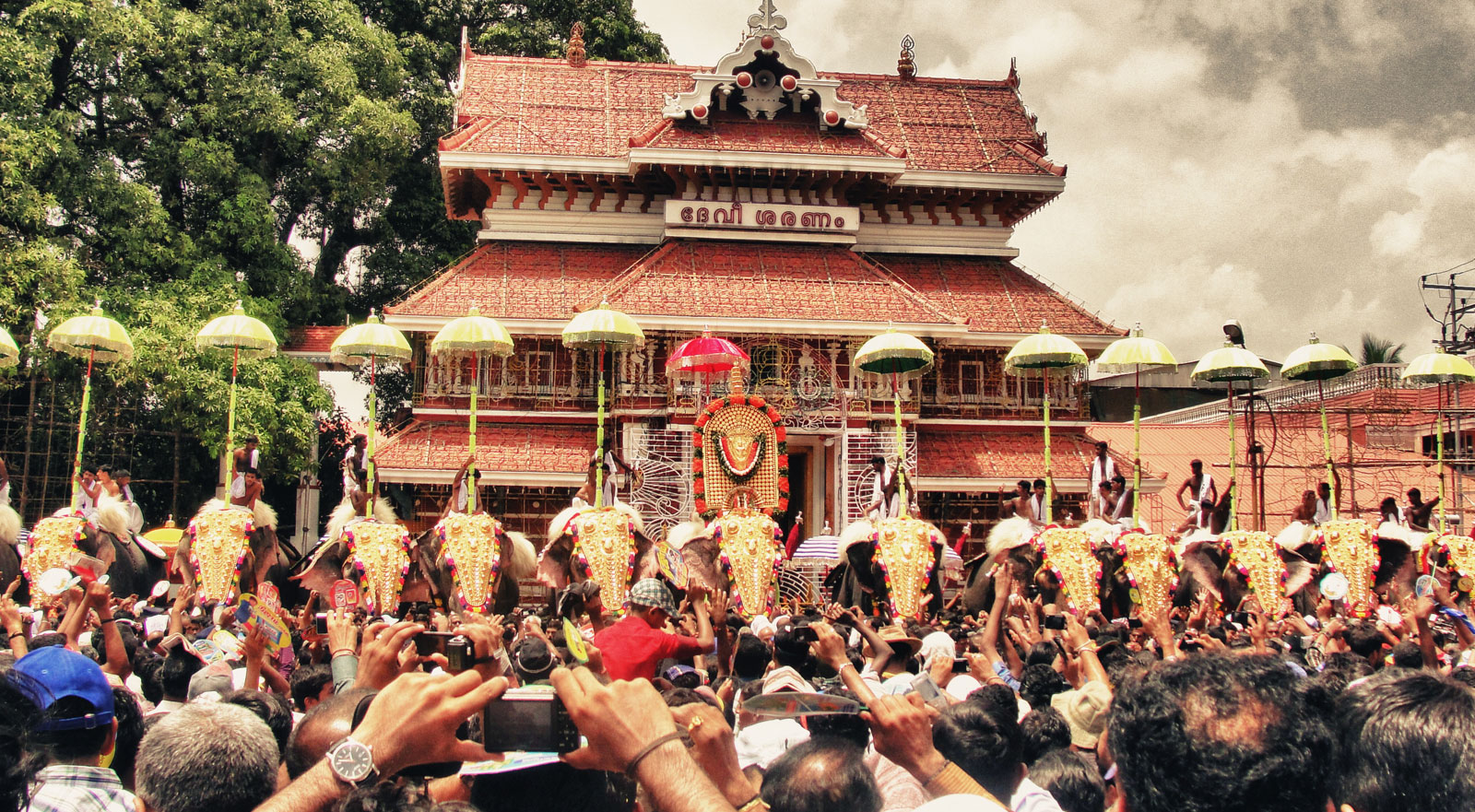
The Thrissur Pooram, celebrated in the Malayalam month Of Medom (April-May) is a grand assembly of Gods and Goddesses in and around Thrissur. These Gods and Goddesses make their visit to the Vadakumnathan Temple premises on caparisoned elephants accompanied by grand ensembles of Chenda melam and pancha vadyam.

The Ten participants of the Pooram are the Thiruvambady Bhagavathi and Paramekkavu Bhagavathi, Nethilakkavu Bhagavathi, Karamukku Bhagavathi, Ayyanthole Bhagavathi, Laloor Bhagavathi, Choorakkattukavu Bhagavathi, Chembukkavu Bhagavathi, Panamukkumpally Sastha, Kanimangalam Sastha. The processions and rituals of each of these deities follow a very strict itinerary, scheduled in such a way that the tempo of the Pooram celebrations – 36 hrs non-stop- is maintained without any loss of energy.
 

HISTORY

Very many stories are told and retold about the origin of Thrissur pooram. Thrissur pooram is 200 plus years young and before that the “Arattupuzha pooram” conducted at Arattupuzha , some 14 km away from Vadakumnathan was the biggest temple festival of Kerala All the temples participating Thrissur pooram and Kuttanellore pooram was the regular participant of ”Arattupuzha pooram” .Once these temples were delayed to attend the festival due to heavy rain or so and then chief of Peruvanam Gramam denied the entry .As an act of reprisal Thrissur Naduvazhi the chief poojari of vadakunnathan , known as Yogadiripad and Kuttanellur Naduvazhi started the pooram in Thrissur. Later due to some reasons the Kuttanellur Naduvazhi disassociated the celebration at Thrissur. Since the withdrawal of Kuttanellur Naduvazhi the glamour of the pooram was lost and the two Naduvazhies’ began to treat each other as enemies. It was in this juncture the former ruler of Cochin, His Highness Ramavarma Raja, popularly known as Sakthan Thampuran (1751-1805 AD) became the Maharaja of Kochi. Sakthan Thampuran unified the 10Temples situated around Vadakumnathan temple and took steps to celebrate Thrissur Pooram as a mass festival. Sakthan Thampuran ordained two groups western group and Eastern group. He named western group as Thiruvambady consisting of Kanimangalam, Laloor, Ayyanthole, Nethilakkavu and Thiruvambady temple (a private devaswom temple). The eastern side called as Paramekkavu side in addition to Paramekkavu temple (a private devaswom temple ) Karamukku, Chembukavu. Choorakottukavu and Panamukkamppilly. The Maharaja re - organized the annual festival in its present form in front of Vadakumnathan. Sakthan Thampuran also directed the main temples at Thrissur, Paramekkavu and Thiruvambady to extent all support and help to other poorams which are coming from 2 to 10 KM. away from Vadakumnathan temple. It is attributed that the event management of the whole pooram was chalked out by His Highness Sakthan Thampuran.
The festival is a congregation of various temple deities in
Vadakumnathan temple premises. During ancient times Thrissur Pooram used to be celebrated with the full involvement of devotees with their physical involvement and voluntary services. The financial obligations were very little due to the availability of large number of artists and artisans locally. Now activities connected with pooram festivals has to be maintained with the help of paid artists and artisans etc., resulting in large expenditure which used to be beyond the capacity of the conveners .The expenditure for arranging , accompaniments and other accessories, hiring of beautiful elephants, artists for melam, panchavadyam for 8days goes into lakhs and lakhs of rupees. As in older times the meager donations from the Thattakams is not sufficient to meet the huge expenses. Large scale contributions were given to communities to conduct pooram with great pomp and show during the time of Maharajas. This help was also stopped and government is not helping Thrissur Pooram Celebration Committee. In this circumstance luckily some new avenues have opened up to facilitate funds for the conduct of pooram with its old pomp and show beautifully and seriously.
The pooram is not only celebrated and conducted by the people from the surrounding locality but cuts cross all the manmade barriers of religion and caste.

THE CURTAIN RAISERS

The city is in jubilant mood since the opening of the pooram Exhibition , the tempo starts with the flag hosting and in full spirit from day before yesterday of the Pooram day. It is in this day the sample fire works is displayed in the vadakunnathan maidan. This is the curtain raiser to the real display of pyrotechnics of the pooram. Started as a sample testing of the fire works for alternation/ modification, it has turned to an event attracting very huge crowd.
Both Paramekkavu & Thiruvambady started to arrange their respective Parasols, Ornaments etc neatly in their stores which started to attract people in a large scale. Now it turned another curtain raiser to Thrissur Pooram.
This “
chamayakazcha”( Viewing the display of decorations &ornaments) is another amazing experience of pooram which is opened for 36 (last two nights and day)
Ritually there is another curtain raiser to Thrissur pooram. The one among the Constituent Poorams
Nethilakkavu Bhagavathi presents herself in front of southern gopuram of Vadakumnathan in the early hours the previous day of the pooram and announces the presence with blowing conch. The gopuram will be opened and Devi enters. It is to be noted that this is the only one occasion the goupuram will be opened in the whole year and will close after the glittering kudamattam .Nethilakkavu bhagavathi pays her respect to lord Vadakumnathan and comes out through western gopuram. There Devi announces the “pooram” by blowing the conch three times at Nilapaduthara. (“Nilapaduthara – about 50 meters north of the western goupuram.) . Earlier this ritual was on the eve of “Kovilakathu pooram” which was conducted the day before yesterday of pooram.

THRISSUR POORAM - THE FORMAT

The participant poorams are divided into two parts namely “Paramekkavu side” and “Thiruvambady side”. The Paramekkavu side consists of besides “Paramekkavu Bagavathy

1) Pookattikkara-Karamukku Baghavathy 2) Choorakattukara Baghavathy 3)Chempukkavu Baghavathy 4) Panemukkumpilly Sastha. Besides Thiruvambady Baghavathy, the Thiruvambady side is having 1) Ayyanthole Baghavathy 2) Nethilakkavu Baghavathy 3) Laoor bagavathy 4) Kanimangalam Sastha.

The Schedule : The 36 hour long pooram follow strict time schedule and prescribed route to pay obeisance to Lord Vadakumnathan. The day starts with “
Kanimangalam sastha” entering to vadakumnathan through southern gopuram and exits through western goupuram While chembookavu baghavathy, panemukkumpilly sastha and Paramekkavu bagavathy enters through eastern goupuram and leaves through southern goupuram.The poorams of Laloor, Ayyanthole, Neithalkavu, Choorakottukavu, moves to thekkinkadu maidan from Naduvilal(west) and enter vadakumnathan through western goupuram leaves through southern goupuram. Karamukku bagavathy moves through manikandall(south) and enters through western goupuram and leaves through southern goupuram. Thiruvambady moves to maiden through Naikanal(North) and enters to Vadakumnathan through western gopuram and leaves through southern gopuram.

 The night route is different since except panemukkumpilly no participant pooram enters to Vadakumnathan. Paramekkavu, karamukku, kanimangalam enters through “
Manikandanal. Ayyanthole, laloor, neithalkavu, chhorakottukavu enters through Naduvilal while Thiruvambady and Chembookavu through naickanal But all poorams conclude at “Nilapaduthara” near western goupuram.

The Paramekkavu & Thiruvambady stops their pooram for fire works at their pandals at manikandal and Naickanal at 3.00 am .these poorams starts at8.00am from respective pandals and concludes at Sreemoolasthanam at 12noon.
 

THE DAY

The pooram starts with the ceremonial entrance of “Kanimangalam Sastha” pooram through the southern goupuram at 7 pm. The sastha normally charterised as the guardian of pooram enters Sree Vadakumnathan premise with 7 caparisoned elephants and nadapady ..The kanimangalam pooram is the only other pooram which is allowed to perform Melam/vadhyam in side the compound wall other than “Paramekkavu” .The pandimelam starts in front of Elinjithara and finishes at in front of western goupuram.

This is followed by the arrival of Panamukkampilly Sathavu, Chembookavu Karthiayani Devi. Karamukku Karthiyani Devi, Choorakkottukavu Durga Devi, Ayyanthole Karthiayani Devi,and Naithalakavu Bhagavathi .

Paramekkavu pooram

The pooram day: The temple opens at 04 am after the routine poojas, Arattu at 6.00 am and other rituals connected to pooram, “nadakkal para” starts. At 12.30 noon Devi comes out and the famous “purappadu” starts with 15 elephants. The melam starts with “Chempada” (longest in duration and magnificent in performance) during these Kudamattam will be performed. The pandy will start at 2.00pm and the procession moves to “Vadakumnathan for the thrilling “elingithataramelam” .At 4.30 pm the melam concludes and the procession exits through southern gopuram “thripuda” melam will accompany the procession. The procession will face the southern gopuram stationing at the round after paying homage to the statue of Maharaja” .Meanwhile “thripuda will conclude after kombhupattu, and kuzalpattu “Panchari” will start. At 5.30 pm Thiruvambady bhagavathi will start decenting and the “Devine Durbar” will start with kudamattam.The greatest show on earth concludes at 6.45 pm and Devi returns to temple with “Nadaswaram”.

Night pooram stats at 10.30 pm with 5 elephants with “Panchavadhyam”.The pooram moves through round west and round south and ends at Manikandanal pandal at 2.30 am.

After the fire works day pooram starts at 7.30am and moves to Sreemoolasthanam with 15 elephants .Another thrilling experience with “pandy melam” and kudamattam pooram concludes at 11.30 am. After the touching farewell with Thiruvambady bhagavathi Paramekkavu Bhagavathi returns with jubilant crowd to abode.

After “parayeduppu” and arattu at “pandijarchira” (western pond) Devi returns to temple and will be received with pandy melam. After kodical pooram Devi takes rest with uttrampattu.

Thiruvambady pooram

The temple opens at 3.00 am after routine poojas and "usha Seeveli" the “nadakkal para starts”. At 7.30 am Devi starts for pooram with Lord Krishna’s “kolam”and devi’s thidambhu.The ensemble moves through shoranur road naickanal,Naduvilal and old nadakavu to Brahmasom Madhom. After erakkipooja the pooram starts with 3 elephants and “ Panchavadhyam”. This famous “madathil varavu”will starts at 11.30 and will play 2 thalavattom in 3 kalams which will be spread over 100 mts. The pooram will enter the western round through pazhayanadakkavu and 4 more elephants join .the sweet and splendid Panchavadhyam will conclude at Naickanal pandal at 3-0 clock. The procession will move to “sree moolasthanam”with 15 elephants and “ pandy melam”.The melam concludes at 5.00pm and enters to Vadakumnathan temple. The famous Divine durbar will starts at 5.30 pm facing the Paramekkavu bhagavathi in front of the southern gopuram..After the “ kudamattam” and homage to the statue of kochi raja bhagavathi moves to “Madhom” for “ irakky pooja”.

The night pooram starts at 11.30 pm with panchavadhyam and ends at naickanal pandal at2.30 am . Devi watches the “ fire works from 3.00 am to 6.00 am and starts the procession at 8.00 am to vadakunnathan with “pandy melam”. The pooram concludes at 12noon After the fare well devi returns. In the evening devi takes holy dip at padijare chira and returns the temple at 7.pm. After “kodikuthu” the pooram concludes.

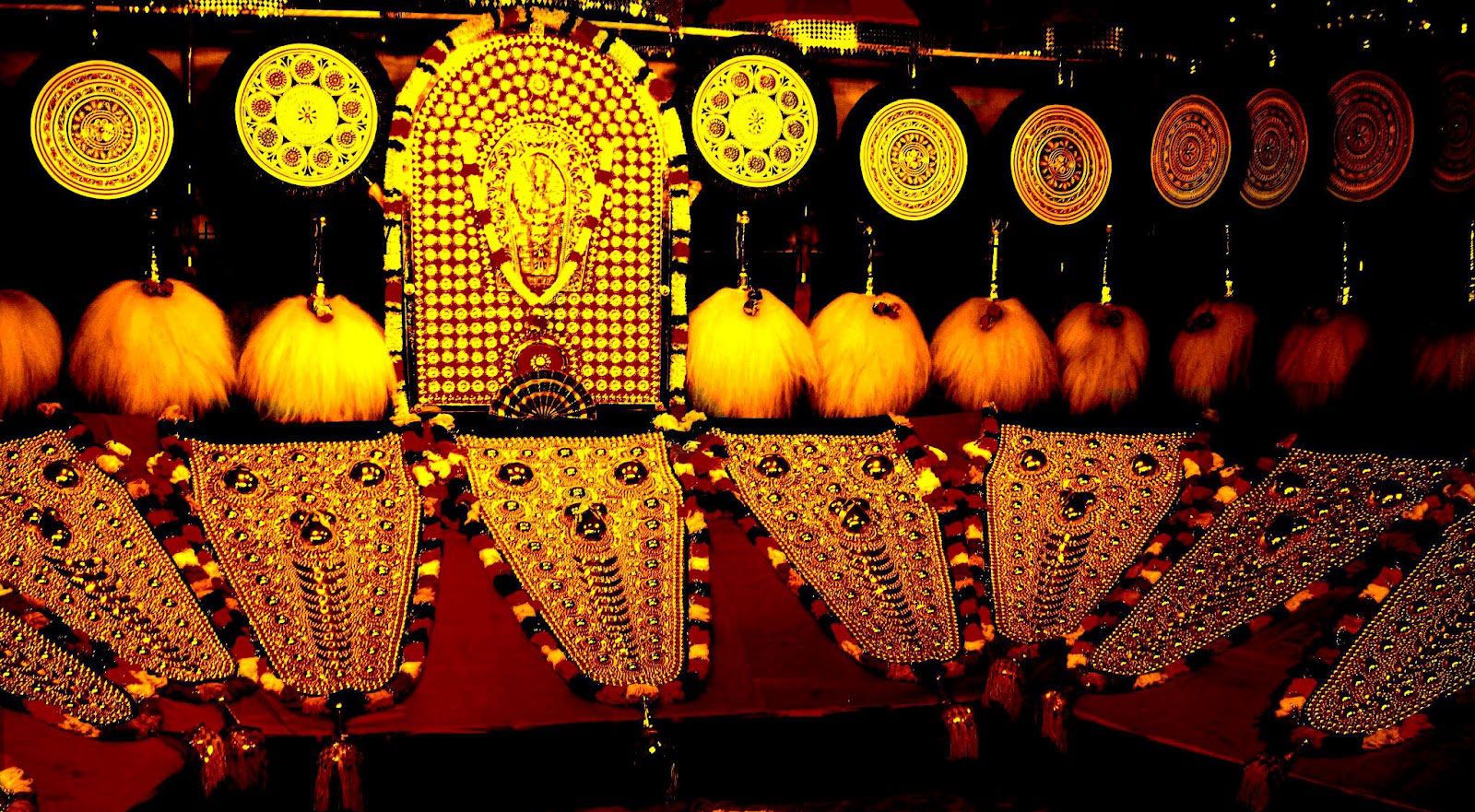
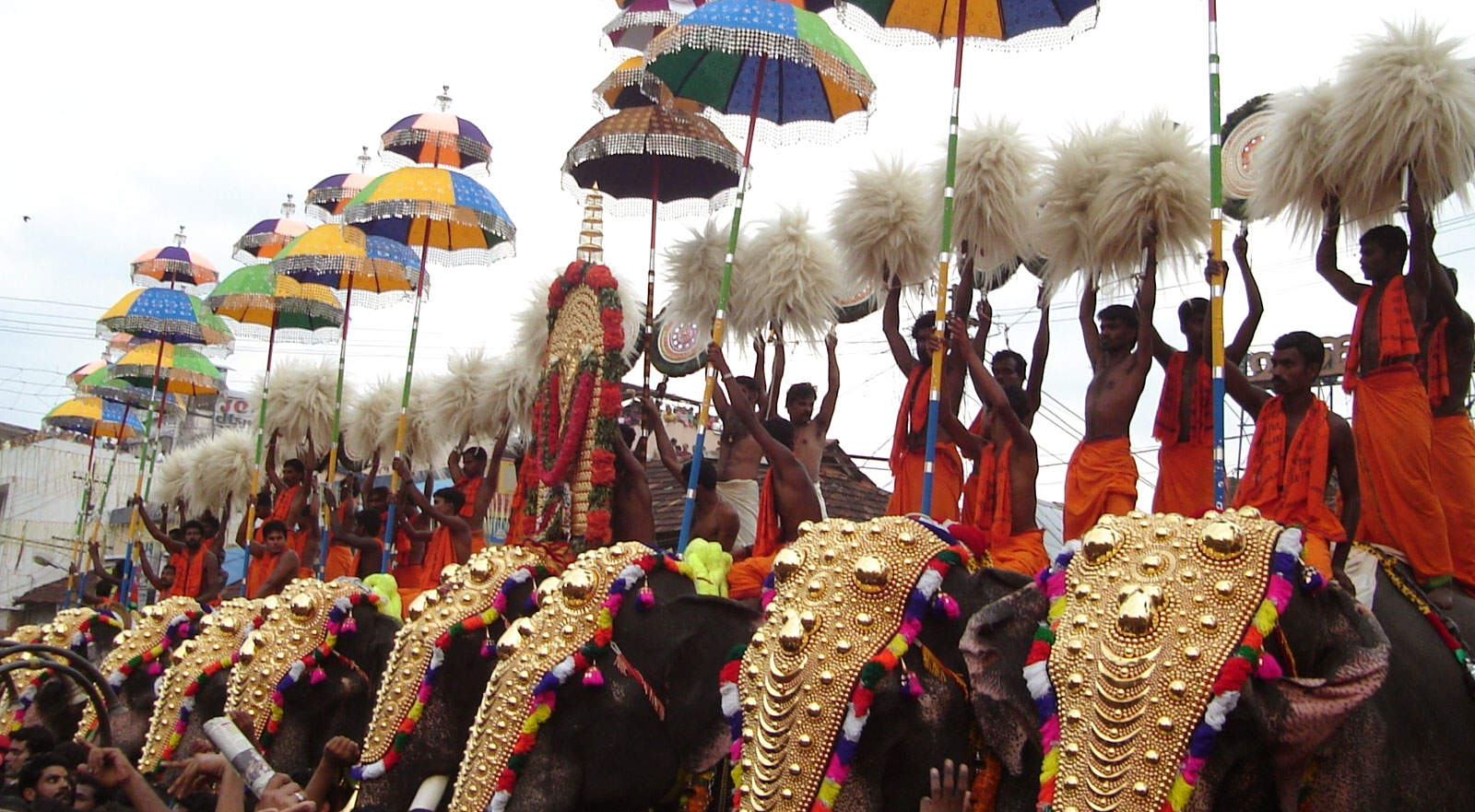
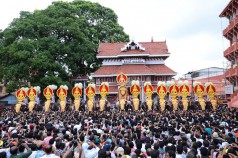
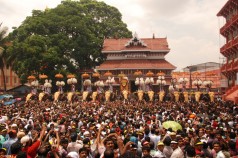
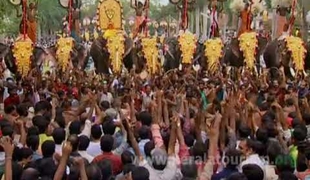
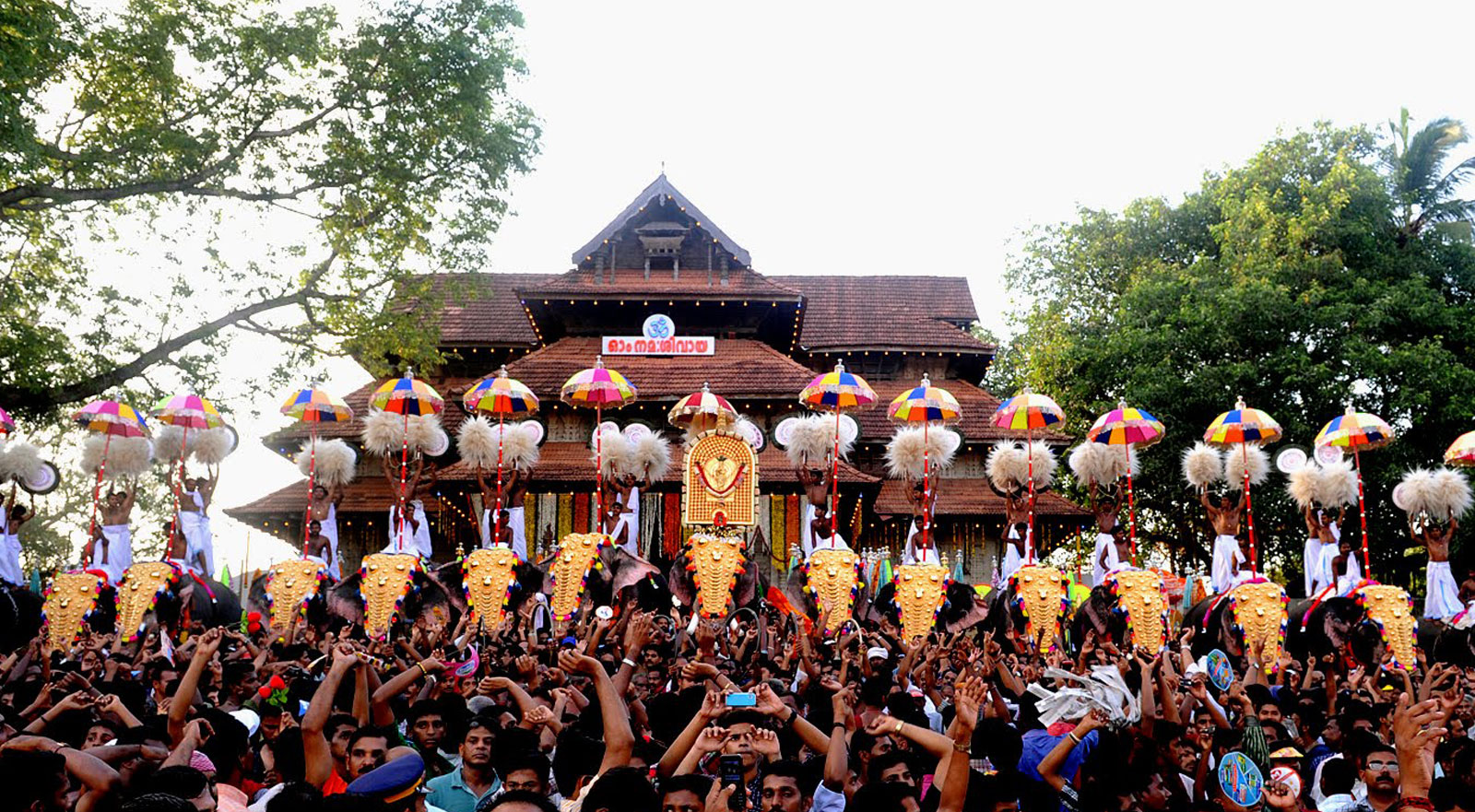
The large number of beautifully caparisoned elephants with multi coloured parasols accompanies by “Panchavadyam” and Pandimelam (Temple instrumental music) and fire works are the main attractions of the Festival. Through the electronic media, its fame has reached all over India and beyond its boundaries, attracting people to flock to Thrissur town to have a glimpse of the pageantry. It is not only Hindus who participate in this festival. Literally Thrissur Town converted into an ocean of humanity of all colour, caste and creed. All houses, shops, temple gopurams are colorfully decorated and illuminated.


RITUALS OF THRISSUR POORAM
 

The rituals in connection with Pooram of all temples are more or less same and there will be slight difference depending on which side the deity is facing.

KODIYETTAM

The Kodiyettam or flag hoisting ceremony is conducted by three different modalities, One as “Dhwajadi” 2)”Anguradi” 3)”Padahadi”. Of all "Padahadhy" is the the oldest form and more liberal. Flag hoisting is done with out any tantric rituals. The post is to be fixed after the Valiya Balikallu and in between outside "Balivattom" &  "Ana kottil". The length of the flag post should be less than the distance between valiya balikallu and nalambalam. The length of the flag stick should be less than the length of fins of nalambalam. The stick should point towards north. The surface of the areca nut tree should be chipped in eight sides. The post should be decorated with Darba, mango leaves & banyan tree leaves in odd times.


UTSAVABALI

this ritual in connection with the celebrations. Right from the day of Kodiyettam to the last day " Bali" is performed with strict discipline. There are specific spots marked with "Balikallu" round the shrine and outside the nalambalam. The thidambu (the replica of deity ) is taken out from the shrine with special vadhya called "Valiyapani" The ritual is pouring "havis" (rice with flowers etc) in the places marked and some unmarked spaces .


Bali is the offering to both natural and supernatural powers both good and bad with respective mantras.

AARATTU

The Thidambu is taken out to the kadavu ( Special place in the temple pond) accompanied by drums etc .After pooja the thantri immerses the thidambu in the water. After this the thidambu will be applied with cosmetics like sandal water, rosewater & turmeric. With new dress (PAATTU) and short pooja & offerings deity will be taken back to temple. This is a daily routine during the 8 days.


POORAPARA

The festivals in Kerala is related to harvest. During the 8 days of pooram the thattakam (domain of influence) will be in festive mood. All the houses will be painted and decorated. The streets will be cleaned and illuminated. The god will travel along the streets with all pomp and show and devotees will offer paddy, fruits etc. The concept is the presiding deity of the place is personally verifying the well being of the devotees and if there is any complaints it will be solved before pooram.


GRAMABALI

The bali is performed after the night rituals in the temple on the day of kodikuthu. It is believed that holy sprits are stationed at entry points to domain, certain trees, around other temples, ponds etc. The chief priest and thanthri presents the offerings at these points in the presence of the deity who is traveling along with. This is nearly an extinct ritual due to the vast area to be covered.

KODIKUTTHU

This the last program of pooram festival. After the holy dip in the temple pond goddess travel back to temple. In between arattukadavu and the flag the kodikalpooram is conducted .After the pooram the elephant which is honored to carry the thidambu pulls down the flag with post. After the sree boothabali the goddesses enter to the sanctum sanctorum and with "Uttram pattu" the god take rest.


CONSTITUENT TEMPLES OF THRISSUR POORAM
 

Apart from the principal deities of the Paramekkavu and Thiruvambadi, eight other temple deities participate in the Thrissur Pooram: six Goddesses and two from temples dedicated o Lord Sastha. They are the Kanimangalam and Panakkampilli Sasthas, and the Bhagavathis from Pookkatikara, Choorakotukavu, Laloor, Naithilakavu, Ayyanthole and Chembukavu. The Kanimangalam Sastha is the first God " - who is the incarnation of "Brahspathi"  (Deva Guru)" - which is the premier pooram entering Sree Vadakkumnathan.

It is interesting to note that only Sastha & Devi are participating in the pooram , may be because of Dravidian influence prevailed that time. There is four nos of siva temples, four nos of durga temples and four nos of large ponds are situated at nearly equidistant from the Sree vadakunnatha temple, the silent spectator of the pooram. Siva temple are "Erattachira –South, Chirakkal- west Asokeswaram –North& Midhunapilly –east. Durga temples are Pookkattikkara – karamukukku, Chiyyaram-South, Laloor south west, Ayyanthole, North west Chembookavu - Northeast.


THRISSUR POORAM
 

Pooram originally denotes the nakshatram or star of the Malayalam month in which the festival is celebrated. It was on pooram days that temples in Central Kerala held their annual festivals honouring their deity with processions of caparisoned elephants and percussion ensembles.

Pooram festival season begins in November and extends up to May. Although there are hundreds of pooram festivals in this season, the most important one is the Thrissur pooram which is celebrated on the Pooram Day of Medom Month of the Malayalam Era (mid-April to mid-May).

Another Pooram of similar significance is the Arattupuzha Pooram which falls on the Pooram Day in the previous Malayalam Month of Meenam.

Pooram festivals are also conducted on other days of the month all over Kerala, the unifying factor being the small processional image of the deity, called the thidambu, which is placed at the base of a golden shield-like kolam, which is mounted atop the tallest male tusker and flanked by other elephants. Though the minimum number of elephants will be three, in the bigger festivals it can be as many as twenty-one or more.


VADHYA KALA
 

Written like a travel guide

The theoretical knowledge will not help to understand and enjoy this complicated art form. The performing art of Kerala is a combination of mathematics and classical music. This is the total symphony of the different sounds produced by entirely different type of instruments, strictly following raga & thala.  So it should be approached delicately as watching an oil painting .Keep a distance, or you will be disturbed by the patches of the brush. The variations in "surthy" from various instruments will be multifold in a closer scrutiny.

Few tips

Thalam: Technically thalam is the division of time.

Thalavattam: is the prescribed time (Say speed) to complete the cycle.

Kalam: The variation in speed to complete the assigned job.

Aksharakalam: To understand the structure of thalam, the time should be defined and it is aksharakalam.( nearly one second) The concept "Thalam" is believed to be "God given" through "Vedas" as retold by "Rishies" (Saints). Lord Siva is always carrying a musical instrument called "Damaru" which can be equated to modern "Chenda", "Madhalam" "Thimila" and "Edakka". The former instruments can easily produce the Premier word of Hinduism "AUM" while the Edakka can pronounce vocal music. In a music concert or in a dance the roles played by instruments are complementary or supplementary but in talavadyangal they are independent.

The artists: Most of the practicing artists in this field are from Marar/Poduval families, a division of Hindu Nair community. Carrying the instrument in one shoulder and the compensation in the form of paddy in a gunny bag in the other shoulder was the picture of theses artists  of late forties. Now the scenario has changed and the artists are well rewarded in all respect. Taught and practiced by "Guru Kula style" each and every artist have a status which is strictly followed by virtue of the artists talent, skill, and  interpretation and not by age.

The Conductor: The senior most artist in Pramanvadhya ( Leading instrument) the conductor of the ensemble. Pramani as the conductor is called will communicate through his body language only. The artist in the right side will receive the instruction from the chief and convey to next artist in the right side in the same manner. The same procedure will follow in the left side also. The chief will supervise the whole performance periodically by turning left, right and to back.


PANCHAVADYAM: This is a most popular art form in Kerala. Panchavadyam has undergone drastic changes-revolutionary, adorable- during last 80 years in every respect.  

Instruments :Thimila ,Madhalam, Edakka, Kombu, Elathalam & Sanghu.

Pramanvadhya ( Leading instrument): Thimila.

The Arrangements: The no of artists varies from 12 to 54 or 55 depending on various factors like duration, place, type etc. The proportion is to every Madhalam, there should be double + one "Thimila" and  for every Thimila there should be equal nos of "Kombu"& "Elathalam". One "Edakka" is essential. For larger no: of artists the no: of  "Edakka" may vary from 2 to 3. The grouping of the artists and hierarchy is strictly followed      

Elathalam Elathalam Elathalam Elathalam Elathalam Elathalam
Thimila Thimila Thimila Thimila Thimila Thimila Thimila
  Sanku
  Edakka
Madhalam Madhalam Madhalam
Kombu Kombu Kombu Kombu Kombu Kombu Kombu

Order: the chief of each instrument will stand in the center and the next one in the right side third one in the left. "Edakka" will be stationed at right-hand side of the "Madhalam" If there is second  "Edakka" it will be positioned at left hand side. "Sanghu" will be at right hand side of the right Edakka.

The vadhyam: The ensemble starts with "Sanghu" which produces the sound "AUM" twice and on 3/4th  way through the third "AUM" "Thimila" and other instruments except   "Kombu" reproduces the same "AUM". Pyramidal in its rhythmic structure the Panchavadyam is divided in 10 "kalams" Starting from 896 "aksharakalam" as 1st "kalam" ending at 1¾ "aksharakalam" as the 10th "kalam" is the format of "panchavadhyam". However theses 10 "Kalams" are grouped to 3 as Slow or "Pathikala" 1,2&3 "Madhya" (intermittence kalam) with 4,5&6 and "Drutha kala" - Speedy kala - with 7,8,9&10. It will take 14 to 15 minutes to complete first kalam. Here the chief will decide from which kalam the ensemble should start. The criteria is the duration allowed. Long vadhyas will start from 1stkalam or 2nd and short from 3rd or 4th. Even though the talam followed is adantha the influence of chempda will be there up to last few "Kalams". Starting from the slow, and lengthy paces the vadhyam reaches to short, speedy " thripuda" ( the thrilling pace of the ensemble)and ends in an explosion of sound. To end this shower of sound there is an exciting piece of art called "Thimila Edachil". Performed in Chempada thalam by few Thimilas and supported by elathalams it is an excellent mixture of skill, speed and sound.  

Maestros in the field (Past& Present-not in order) 

Annamanada Parmeswara Marar & Peethabhara marar, Thiruvillamala Venkideswara Ayer(Venkichen Swamy), Punnathur Madhavan Nair, Pallavoor Maniyan, PattararathSankaramarar, Machad Nanu Nair, Kuzoor Narayana Marar, Kadavalloor Aravindakshan, Chottanikkara Narayanan & Vijayan, Kalamandalam Parameswaran, Thrikkur Rajan, parakkat thankappan etc.

Chenda Melangal:  is the most popular and widely acclaimed keshtra vadhyas of Kerala. More than 300 years old melam is an integral part of all festivals in Kerala irrespective of cast or religion. The most important among these melams are "Pandy" (Splendid &Majestic) and "Panchari" (sweet & pleasing) which may extent up to 5 hours. The leading instrument is "Chenda", Kerala's own instrument.   The Chenda is divided into  "Valamthala Chenda & Edamthala Chenda" (right & left side of the instrument) or  "Veekam Chenda" & "Uruttu Chenda". The covering is soft in Edamthala but in layers in Valamthala.

 Chenda can produce multiple vadhyas the "Devavadya" using "Valamthala" and Asura vadhyas through "Edamthala". With infinite range & magnificent sound  "Chenda" is above all 18 instruments.


Chempada Melangal: Generally there are 7 types of melangal viz: Panchari, Champa, Chempada, Adantha, Anchadatha, Druvam and Pandy.  The earlier 6 melams are called " Chempada melangal" and they are one way or other closely associated and the model is the premier one "Panchari". Of all "Pandy" stands distinctive.  Two more melams, "Navam" & "Kalpam" were developed by a Maestro in the field Sri Kumarapuram Appu marar.

There are  few artists to perform  all these melangal at an  equal ease with total dedication, interpretation, meditation, skill & talent.

Some of the past and present are : Pallavoor Appu Marar, Thripekulam Achuta marar, Chakkumkulam Appu Marar, Kachamkurichikannan,Kelath Aravindakshan, Pervanam Kuttan, Mattannur Sankarankutty ( with out any prejudice or order)

Instruments :Chenda, Kurumkuzal, Kombu, Elathalam .

Pramanavadhya (Leading instrument): Uruttu Chenda

Role of each instrument in general:

"Uruttu Chenda"- To lead the orchestra.

 "Veekam Chenda"- to keep the thalam

"Elathalam" – To support the Veekam Chenda

"Kombu & Kuramkuzal" To keep the orchestra with in the prescribed limits and to blend & balance.

The melangal are performed in a tight format without any compromise and each and every instruments has equally important role to perform and the conductor will see that all are in tune &time with one another.

The no: of artists: Kurumkuzal & Kombu may be in equal numbers with "Uruttu Chanda", Elathalam must be in double and "Veekam Chenda" should be triple the numbers of "Uruttu Chenda". The ratio of  "Veekam" to "Uruttu" may be 1:6 for magnificence.

The Arrangement:

Kombu Kombu Kombu Kombu Kombu Kombu Kombu
Kurum Kuzhal Kurum Kuzhal Kurum Kuzhal Kurum Kuzhal Kurum Kuzhal Kurum Kuzhal Kurum Kuzhal
Chenda Chenda Chenda Chenda Chenda Chenda Chenda
Elathalam Veekum Chenda Elathalam Veekum Chenda Elathalam Veekum Chenda Elathalam Veekum Chenda Elathalam Veekum Chenda Elathalam Veekum Chenda Elathalam Veekum Chenda Elathalam Veekum Chenda Elathalam  Veekum Chenda

The positions are arranged such way that to have a direct interaction between the artists. "Kurumkuzal" is holding the wand supported by the "Kombu" so both these artists must have direct Eye contact with the Leader.

Common features : All these Chendamelangal have common  Features like same instruments are used, positions and duties are same .Performed in ever increasing tempo and the proportionally decreasing number of beats in the cycle. The role of the "Pramani" and the hierarchy are identical in vadhayam & melam.


PANCHARI: Performing on Chenda with one stick and hand (R&L) is the simple identification of this form. Divided into 3 steps in 5 "Kalams" the concert starts at 96  "aksharakalam" and ends at 6 "aksharakalam". The 3 steps are classified through the mode of using the stick. The first one "Nerkol" ( slow) is beating directly perpendicular to the surface of Chenda. On to second step both beats are in swinging mode with  a slight inclination. The second stage is called "Thakkida" (Normal)and third as "Kuzamarinja" kalam (Fast)step. The wrist of the hand will fully rotate in the third.  "Kalamidal" ( take off) is the foundation of Panchari and the blue print will be ready after the "12th  chempada vattam" (Aksharakalam" divided by 8 is one chempada vattam). The melam starts (airborne) at the second part of Vilambakalam (pathikalam) - called Varthikam. The melam smoothly travels to 2nd , 3rd  4th & 5th Kalam ( in 6,3,1½,3/4 – chempada vattams)and completes in "Theerukalasam".  The 5th kalam is entirely different & more jubila. Listening to "Panchari" the melam with an eminence" is like watching the Tidal waves from shore.

Thalam :Chempada till 5th Kalam, Panchari in 5th  again chempada in "Theerukalasam" Ragam : Sankarabharanam.


PANDI: Clearly perceptible, widely acclaimed, "pandimelam" attained towering heights due to its performance in "Elajitharamelam" of Paramekkavu in Thrissur pooram. The pandimelam is distinct from other Chenda melamgal. The fundamental change is the use of stick in both hands.  Pandi is like climbing a stair case. No. Of Steps + Landing again No. Of Steps + Landing and finally at the top of the tower (explosion of sound) The "takeoff" is in an entirely different format called "Kolumbal/Koottiperukkal" which is an enchanting experience. It is difficult to confine " Pandy" to "kalam" or "Aksharakalam". The pandy is designed in such a way that it is accelerating step by step very systematically. During the course of time it will cover up the kalams, not strictly  time- bound. The beauty of Pandy is its "Kalasams". Normally after 4 Thalavattam " "Kalasam" is performed in 3to 6 thalavattams (Subject to the speed of the melam). kalasa thalavattangal is done through "Nerkol" which  shows the nobility and depth of the Pandi. The speed and no of beats are directly proportional. 100 and odd Chendas in "Nerkol" complemented by another 50 and odd instruments- the grand finale of "PANDYMELAM"- is a thrilling  experience .

Thalam: ADANTHA   Ragam : BHAIRAVI

Some maestros in the field-Chenda (without prejudice/ order) Peruvanam Narayana marar, Thrippekkulam Govinda marar, Peruvanam Appumarar, Thrippekulam Achuthamarar, Pallavoor Appumarar, Chakkumkulam Appumarar, Pervanam Kuttanmarar, Mattannur Sankarankutty marar, Peruvanam Satheesan Marar, Cherussery Pandarthil Kuttan Marar


THAYAMBAKA: This is another illustrative art form in Vadhyakala and more or less a one man show. Supported by "Elathalam" the thayambaka is performed in "Chenda". Classified as a temple art "Thayambhaka" is staged in between the "deeparadhana" and "athazapooja" Of the temple ( just after the wee hours of the day). The venue is after the "Valiya balikallu" &  before the  "Balivattom".

The duration is 1¼ hour which may vary from ½ an hour to 1½ hour It is a thrilling experience to watch a "Thayambhaka". In front of the holy lamp the supporting artists are lined  leaving the center space for the Maestro, as

         
    Veekum Chenda Elathalam  
Elathalam     Veekum Chenda  
Veekum Chenda     Veekum Chenda  
 

The programme starts with a typical style "Kottivekkuka" by  "Valamthala" Chenda, supported by "Elatahalam". Starting from "Thripuda" and turning to "Ekathala" ( eka means one) the  melam enters the last phase of the preface of  "thayambaka" . Here enter the master of the ensemble and positions at the center and beats twice  and the concert  starts. From "Pathikalam" (slow pace - Chempadavattom)  "Thyambhaka"  steadily travels though  various steps like  "Kooru" "Edavattom" 1st stage  & 2nd stage ," "Edanila" & "Erikida" . Here the "Thayambhaka" ends with  a shower of downfall. Single/double/ triple/ penta "Thayambhaka" - According to the no. of  "Pramanies". The no: of  "valamthala & Elathalam" may be increased but the "Edamthala" remains on two.

Some masters & their way of handling " thayambhaka"  

Aliparambhu Sivarama Poduval- systematic & pure  

Kallur Ramankutty Marar- Vibrant  

Mattannur Sankarankutty Marar- Sweet and classic  

Porur Unnikrishnan- Explosive.

Pallavoor Appumarar & Kunjukuttan Marar, Pookattiri Divakara Poduval,Thrithala Kunjukrishna Poduval &Kesava Poduval are some of the masters in this field with proven track record.


VALIYAPANI: Instruments used are SANGHU, CHENGILA, ELATHALAM, KOMBU, KUZHAL, Chenda & maram. There are two type of pani –big and small. Valiya pani is again divided into saivapani & vyshnavapani. The earlier is nearly extinct and latter is used during festivals only.

In a nut shell:   Advaita Vedanta is considered as the culmination of rational thinking in India. The absolute of this philosophy can be represented by the syllable "Aum". This is  also known as  "Pranava".The real point of this pranava lies in the fourth state which is termed as "Turiya" – the measureless one (amantra).It may be pointed out  that these forms of Kerala vadhyangal somehow accommodate this philosophy. Mathematically multiplying odd no. with even no. is "Panchavadyam & Pandimelam (7*2=14). And with even no. with  even no is "Panchari (6*2=12).The melam which uses hand & stick-may be considered as "Swathika" (Bramanya) and using both sticks the "Pandy melam" as rajaswa(Kshatriya) combination of these Swathika" & rajaswa is  "Pancha vadhyam". The gist of all these is "Thayambaka". One who mastered in "Thayambaka" can perform any talavadyangal.


THE FIREWORKS DISPLAY
 

Fireworks are an essential part of almost all events in Kerala .But in Thrissur Pooram; the fire works are distinct in character, performance, excellence and magnitude. Both Thiruvambady and Paramekkavu temples compete with each other to provide the crowd with the best and the most unexpected.
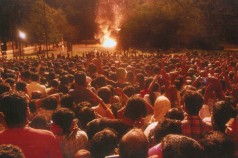
 People come from faraway places to watch this amazing display of pyrotechnics. There are four major firework displays in Thrissur Pooram. The ‘sample fireworks on the day before the Pooram, the colorful sparklers that light up the sky (amittu) by both sides on the Pooram evening after the Southward Descent, the most impressive event  that mark the peak of Pooram celebrations in the early morning hours, and the final fireworks the following noon after the Goddesses bid farewell to each other that mark the end of Pooram.

The chemistry : The technique is a mixture of sound, light and strength, the proportion may vary according to the type –say amittu( less sound more colour full), dynamite (High pitch sound only) Earlier potassium chlorate was used to increase the loudness and was replaced by potassium nitrate since earlier is more accident prone. The colour full display of amittu was started in Thrissur pooram . Thanks to Dr.T.C. Krishnamenon for his able guidance.

Some of the combinations

Stonshiam Carbonate – Dark Red

Lithium Carbonate – Light Red

Calcium Chloride - Orange

Sodium Nitrate - Yellow

Barium Chloride – Green

Copper Chloride –Blue

Titanium and Aluminum – White

This is only a guide line and proportion is the skill of the technocrat and Aluminum powder, magnesium etc are added to give some gimmicks.


According to sources, an active member of Thrissur Pooram committee witnessed a Chinese firework display during his visit to the Park Fare Exhibition at Madras about 80 years ago. Inspired by the spectacle, he brought some items of Chinese fireworks to Thrissur like
poothiri, lathiri, moolipeevu, vaanam etc. It obviously fired popular imagination and in no time, the art and craft of fireworks was taken up by enterprising indigenous families, who developed it into the pulsating event that it is now. Every year new and never-seen-before items are added to the fireworks, with both the temples devoting a large share of resources for it.

The earliest masters of fireworks display, like
Kuriya, Ponnuveetil Gopalan Nair, Vellattu Narayana Panicker, Chelapadan Anthony, Vadakkethala Kochapu etc were not formally or technically trained in the art. They learned it through experience and experimentation and virtually developed it into a major industry. All the fireworks-managers of today are the followers of these pioneers. For a long time the responsibility of the Paramekkavu fireworks was vested with Karayarakattil Jose, who has now retired from the scene.
 
It was only in the early 1970’s that a fixed schedule for fireworks display was introduced. Until then whichever party -  
Paramekkavu or Thiruvambady - that reaches the pandal first would begin their fireworks display. As this led to a lot of misunderstandings and also untoward incidents, a rotation system was introduced. According to this, each temple would take turns to light their fireworks first. From then on, both the parties have followed this system.

The fame of the Thrissur fireworks crossed boundaries and reached USA and a master was invited to display fireworks in connection with a presidential Sworn - in USA

The Trichur Pooram Exhibition

The Trichur Pooram Exhibition, yet another major attraction of the Pooram is The Trichur Pooram Exhibition one of the biggest Trade Fairs in south India . It is an all-India exhibition that generates significant revenue for the Pooram organisers. The Exhibition which starts a month before pooram was conducted in the vicinity of Vadakumnathan. Venues and organizers changed during the course of time. Thrissur Municipality, entrusted Y.M.A to run it in the year 1933 and afterwards to the stadium committee. In the 1964 the two groups of temples requested the municipality to allow them to run the exhibition to meet the expenses of Thrissur Pooram. In this year these 9 temples joined together ( the 10th pooram Panemukkuppily stopped long before this ) and refused to stage their respective poorams in support of this demand .That year all temples staged the pooram with one elephant just only to meet basic temple rituals. This hurt the feelings of devotees, traders, artists, artisans and people of all walks of life, Tourist Development Corporation, Thrissur Municipality ,respective Panchayaths and Government in general. They started negotiations with these 9 temples through their office bearers and ascertained from them the hardships experienced for conducting the Pooram.

Ultimately Thrissur Municipality admitted the demand of the 9 temples was just and genuine and the right to conduct the pooram exhibition was handed over to” Pooram Nadathippukar” ( the people who are authorized to conduct poorams).This exhibition is the showcases of pavilions and stalls of major commercial, industrial and entertainment houses in the country.

The exhibition profit could be used exclusively for conducting Thrissur Pooram Festival but unfortunately this was diverted for other purpose and only a part of it is used for Thrissur Pooram Festival. This is against the principle of “philanthropic Purpose”. At the same time the Constituent Poorams of 8 temples find it very difficult to celebrate their festival with pomp and decorum as the office bearers of these temples feel hardship and financial difficulty.

Under these circumstances the 8 temples put-up their demand for participations in the exhibition committee and equal share from the funds generated from it .As the demand turned to civil case and interim judgment, the respective Exhibition committees started to give small contribution to 8 Constituent Poorams annually

OTHER ATTRACTIONS

Apart from the Thrissur Pooram another local attraction is the “Puli Kali” (Tiger Play) and “Kummatti” (Mask Dance) that form part of Onam celebrations, the national festival of Kerala (Aug-Sept). These consist of enthusiastic processions of men painted and made-up as tigers, all members of different clubs that organize the event. Thousands gather to watch the ‘tigers’ dancing to the beat of drums.

   The biggest and tallest church in South Asia Our Lady of Dolores popularly known as the New Church [Puthenpalli] and  the first Catholic Church in India, Metropolitan of the Chaldean Syrian Church (the name used for the Church of the East in India) are other places to note in  Thrissur 

The foremost mosque in India Cheraman  masjid which is  dated back 7th century AD, is in Kodungallore of  Thrissur  Dist .The internationally acclaimed Kerala Kalamandalam, a state academy for the promotion of classical arts is also situated at Cheruthuruthy, around 30 kms from Thrissur town. Kerala Sahithya Academy, Sangeetha Nataka Academy and Kerala Lalithakala Academy (State Academies of Literature, Fine Arts and Theatrical Arts) are head quartered at Thrissur making the epithet ‘cultural capital of Kerala’ really significant.


IMPROVES  /  MODIFY THRISSUR POORAM
 

The Thrissur pooram which is celebrated during the month of April-May is one of the greatest festivals of elephants and drums. The grant show of temples in the vicinity of the vast Vadakkumnathan temple was started in the present form by the great visionary the Sakthan Thampuran, the ruler of the Cochin State. Now the pooram is celebrated with processions from various temples consisting of caparisoned elephants decorated deities embedded in golden Kolams held with colorful specially prepared large umbrellas and Alavattam made out of peacock feathers and Venchmarams. Each of these decorative items are held and exhibited according to the beating of drums by trained men sat over the elephant.

The accompaniment to the elephants stationed in front of elephants consists of drummers, officials of the temple and residents of that particular area mostly the devotees of that temple .as Thrissur pooram has become one of the greatest attractions of the people not only from Kerala but also from other countries of the world, the responsibility of the local administration and the organizers have become much more than the usual rituals. Now they are trying to improve the show by adding improved themes in the show. This will also help to minimize the monotony of locals who throng to the venue every year.

The two main poorams of Paramekkavu and Thiruvambady has already accomplished this by improving the kudamattam and fire works. But the other poorams are still lagging behind in this process due to financial crunch and other problems. Due to the initiative taken by the Tourism Department of Kerala Government and the Cochin Dew Swam Board these poorams are also trying to improve and innovate their processions with new ideas.

Since Thrissur pooram is commonly known as drum criented festival, the improvements
should be limited to the present structure so that it should cater with the taste of visiting people consisting of large number of foreigners and non-Malaya lees. The present forms of Melam and panchavadyam are the live wires of the show and this should be improved with well known artists accompaniments.

The restrictions and the time limit in the Thekkinkadu Maidan also hamper them considerably. Taking into all these aspects including the thin attendance in the main through fare like the Kuruppam Road and M.G. Road from where all these poorams originate should be the focal point for improvisation. These will attract more tourists to these pooramseven before entering the main venue, the maiden.

The restrictions and the time limit in the Thekkinkadu Maidan also hamper them considerably. Taking into all these aspects including the thin attendance in the main thoroughfare like the Kuruppam Road and M.G. Road from where all these poorams originate should be the focal point for improvisation. These will attract more tourists to these pooram even before entering the main venue, the maiden.

During the procession including the start of it, the following forms of drums which is suitable to amalgamate with our drums and processions can be included in intervals as this temple rituals from other parts of our country which has now started coming out of the walls of temple are attracting large number of people when they are shown along with various programmers.

Some Interesting Indian Art forms (general information).

Pang-cholam

This is Manipuri drum dance where the drummers and musicians will dance along with the music and the sound in different formation vary vigorously and it is a treat to watch.

Bowl singers of Bengal

This art form the singers have two instruments, one is called a string instrument and the other one is a small thabala and they will be singing, dancing and drumming and moving from one place to another in different formations. This is a very melodios traditional, religious and ancient art form they sing Bhajans of various Gods.

Chatu dance of Orissa

Puruliya, Mayur Bhang and Sarai kela

There are physical movements similar to marshal arts (rigorous) with very large size drums and Musical instruments.

Lasam from Gujarat

In this form the instrument is called lasam and with help of this they sing and dance in different combinations.

Bangda from Punjab

In this dance form men wearing colorful dresses with turban on their head will drum and dance in different formations.


Home  |  Thrissur Pooram  |  Gallery  |  Spectacle  |  About Thrissur  |  Links  |  Sitemap  |  Contact Us  |

Thrissur Pooram Co ordination Committee, Thrissur, Kerala, India. Email - mail@thrissurpooramfestival.com
Ph: +91 487 2423696, 487 2387563, 487 2306611

Copyright © 2007 www.thrissurpooramfestival.com. All Rights Reserved.
Site powered by: Keralainfotech.com